Did you know there are two global lipedema organizations and they have a major disconnect? Did you know there’s an organization that is trying to rename lipedema to “lipalgia?”
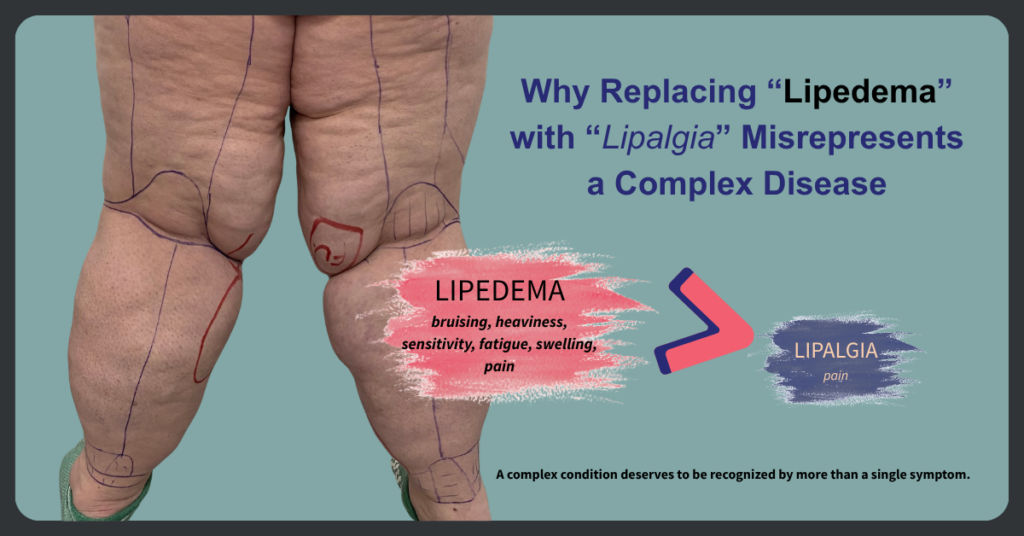
Did you know I personally don’t agree with that name change? Do you also know that I 100% question the motives behind this proposed change, openly. I want to be clear on where I stand personally. Lipalgia oversimplifies our complex condition involving multiple hallmark symptoms including easy bruising, fatigue, heaviness, pain, swelling, abnormal fat growths (and so on), and implies that painful fat is THE symptom. I do not agree with it.
Why changing the name of our disease to “lipalgia” is premature and in my opinion, incorrect, and why getting the science right matters to all of us.
As someone who lives with lipedema and spends considerable time advocating for better recognition, research, and treatment, I believe we need to be careful about replacing the name of our disease with lipalgia syndrome.
I understand the argument for emphasizing pain. Pain is a major symptom for many people with lipedema. But pain is not the whole disease, and I am not convinced that changing the name is supported by sufficient scientific evidence.
I’m going to say it: I also have questions about the motivation behind this proposal. I said it.
What is the real motive behind changing the name of lipedema to lipalgia syndrome? Given Germany’s recent expansion of insurance coverage for lipedema surgery, is there any possibility that this proposed change is connected to efforts to reduce government healthcare spending on treatment? Has anyone independently examined whether changing the terminology could affect patients’ eligibility for coverage or access to care?
I am not accusing anyone of having this motive. I am asking for transparency. The organization leading this effort should explain who initiated it, who is funding or supporting it, what scientific evidence justifies it, and whether financial, political, or healthcare policy considerations have played any role. Is someone trying to save a bunch of money by not treating patients with a name change???? Hm.
Patients deserve answers before a change with potentially significant consequences is embraced.
Lipalgia Is a Symptom, Not a Substitute for a Disease
Lipalgia literally refers to pain involving fat tissue. But painful adipose tissue can occur in conditions other than lipedema, including inflammatory disorders and other medical conditions.
Lipedema can cause lipalgia, but not all lipalgia is lipedema.
Replacing the name of a recognized clinical disorder with a term describing one symptom raises an important question: Would this improve diagnosis, or would it make it harder to distinguish lipedema from other causes of painful tissue?
Lipedema can involve pain, tenderness, easy bruising, heaviness, swelling, and changes in limb size and function. A name focused primarily on pain may not adequately represent this range of symptoms.
We should not narrow our understanding of a complex disease before the science supports doing so.
Are We Too Quick to Dismiss Swelling and Fluid Abnormalities?
I am also concerned about categorical statements that lipedema involves no edema or abnormal tissue-fluid handling.
In my experience as a stage III lipedema patient, swelling is one of my most persistent symptoms, even after three lipedema removal surgeries. Many people in the lipedema community report swelling that varies with heat, travel, and other circumstances. Personal experiences cannot establish a mechanism for everyone, but they deserve to be considered alongside clinical research.
We also need to distinguish between classic pitting edema and other possible tissue-fluid abnormalities. The absence of pitting does not, by itself, establish that tissue-fluid handling is normal.
Research is giving us objective ways to investigate these questions.
What the Research Is Showing
Studies by Crescenzi and colleagues in 2018 and 2020 reported elevated tissue sodium measurements in women with lipedema compared with controls.
A 2026 quantitative MRI study by Nöll and colleagues further examined tissue sodium and water-sensitive measurements in women with lipedema. The researchers reported elevated sodium measurements in several tissues and associations between some measurements, disease stage, and pain.
These findings do not prove that excess fluid causes lipedema or explains every symptom. Tissue sodium measurements are not equivalent to proof of excess extracellular water. But they do give researchers important questions to investigate.
Nöll and colleagues also reported that a single session of manual lymphatic drainage was associated with reductions in tissue sodium measurements and self-reported pain. This was an immediate, single-session study, so it cannot establish the long-term effects of treatment or prove why pain improved.
Other research, including a 2021 randomized controlled trial of conservative treatments, has also examined changes in pain, limb volume, and physical function.
Taken together, these findings do not settle the debate about fluid involvement. They do, however, make further investigation reasonable.
We should be investigating these findings, not dismissing the possibility of a tissue-fluid component before we fully understand it.
Why the Name Matters
Medical terminology influences how clinicians communicate, how researchers classify patients, and which questions receive attention.
We still have much to learn about lipedema, including how adipose tissue abnormalities, inflammation, tissue remodeling, vascular and lymphatic structures, and fluid handling may interact. These processes may not be identical in every patient.
That uncertainty should encourage more research, not a premature conclusion about what the disease is or is not.
I support improving medical terminology when strong evidence demonstrates that a change will improve understanding and patient care. I simply do not believe we have established that replacing lipedema with lipalgia syndrome would accomplish that.
Where I Stand
I want better recognition, better treatments, and more effective research for everyone living with lipedema.
We can recognize pain as an important symptom without defining the entire disease by it. We can distinguish lipedema from lymphedema while continuing to investigate possible connections in tissue-fluid physiology. And we can acknowledge the limitations of current research without ignoring findings that deserve further study.
I am not ready to give up the name lipedema in favor of lipalgia syndrome. I believe the proposed change is premature, and I want to see a stronger scientific and clinical justification before it moves forward.
I also want direct answers about who is driving the change, why it is being proposed, and whether any financial or policy considerations have influenced the effort.
Our priority should be understanding the disease in all its complexity, not adopting a new name before the science is settled.
People with lipedema deserve rigorous research, transparent decision-making, and terminology that serves their best interests.
I am not ready to give up the name lipedema. I am ready to keep asking the questions that will help us understand it better.
References and Further Reading
- Kruppa P, Crescenzi R, Faerber G, et al. Lipedema World Alliance Delphi Consensus-Based Position Paper on the Definition and Management of Lipedema: Results from the 2023 Lipedema World Congress in Potsdam. Nature Communications. 2026;17(1):427. https://doi.org/10.1038/s41467-025-68232-z
- Crescenzi R, Marton A, Donahue PMC, et al. Tissue sodium content is elevated in the skin and subcutaneous adipose tissue in women with lipedema. Obesity. 2018;26(2):310–317. https://doi.org/10.1002/oby.22090
- Crescenzi R, Donahue PMC, Petersen KJ, et al. Upper and lower extremity measurement of tissue sodium and fat content in patients with lipedema. Obesity. 2020;28(5):907–915. https://doi.org/10.1002/oby.22778
- Nöll E, Henkel A, Cornely ME, et al. Manual lymphatic drainage reduces tissue sodium and self-reported pain in women with lipedema: a quantitative MRI study. Frontiers in Cell and Developmental Biology. 2026;14:1808579. https://doi.org/10.3389/fcell.2026.1808579
- Podda M, Schmidt J, Cornely ME, et al. Liposuction versus conservative therapy for patients with lipoedema in Germany: a multicentre, randomised controlled clinical trial. The Lancet. 2026;408(10558):910–923. https://doi.org/10.1016/S0140-6736(26)00910-4
- Atan T, Bahar-Özdemir Y. The effects of complete decongestive therapy or intermittent pneumatic compression therapy or exercise only in the treatment of severe lipedema: a randomized controlled trial. Lymphatic Research and Biology. 2021;19(1):86–95. https://doi.org/10.1089/lrb.2020.0019
- Cifarelli V. Lipedema: progress, challenges, and the road ahead. Obesity Reviews. 2025;26(10). https://doi.org/10.1111/obr.13953